100% Handcrafted with care, in Canada

French

100% Handcrafted with care, in Canada

Menu

(509) 300-2002

Measurement guide

Before we start

Tools required

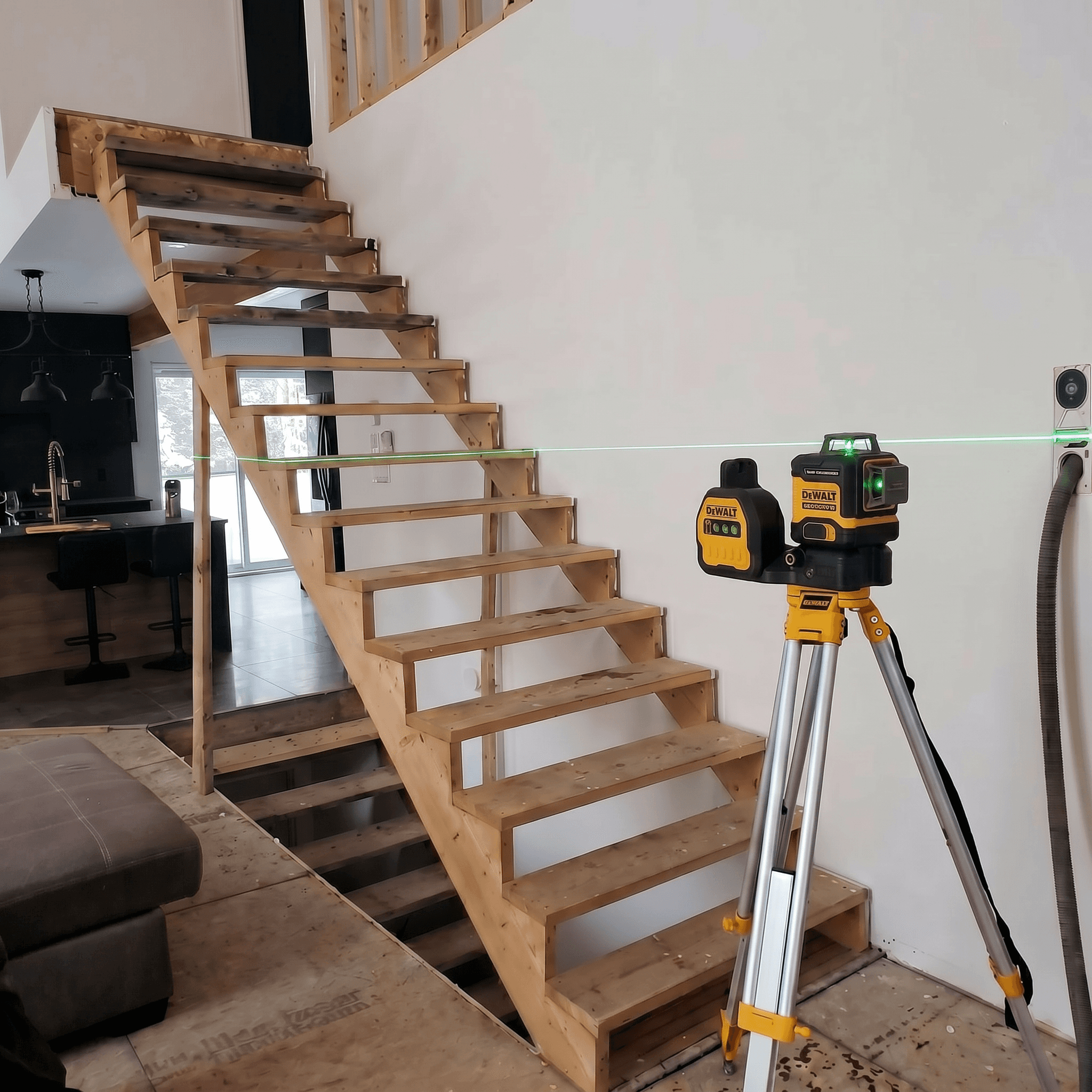
• Laser level

• Pencil and notepad and ruler

• A high quality tape measure

• The measurement pdf printed out

Important disclaimer

MetalStairs Co. is not responsible for errors in measurements provided by the client. Any order fabricated according to client-supplied measurements is considered correct as submitted. Additional charges apply for any modifications required due to incorrect measurements. If you have any doubt, contact us before submitting. We also offer an on-site measuring service, reach out to learn more.

If we install for you

Send us photos or a short video of the full path from your entrance to the install location. A straight stringer can be up to 15 feet long. The more we can see, the better.

Straight stringer

The more photos and videos you send, the faster we can quote and the less back and forth before fabrication.

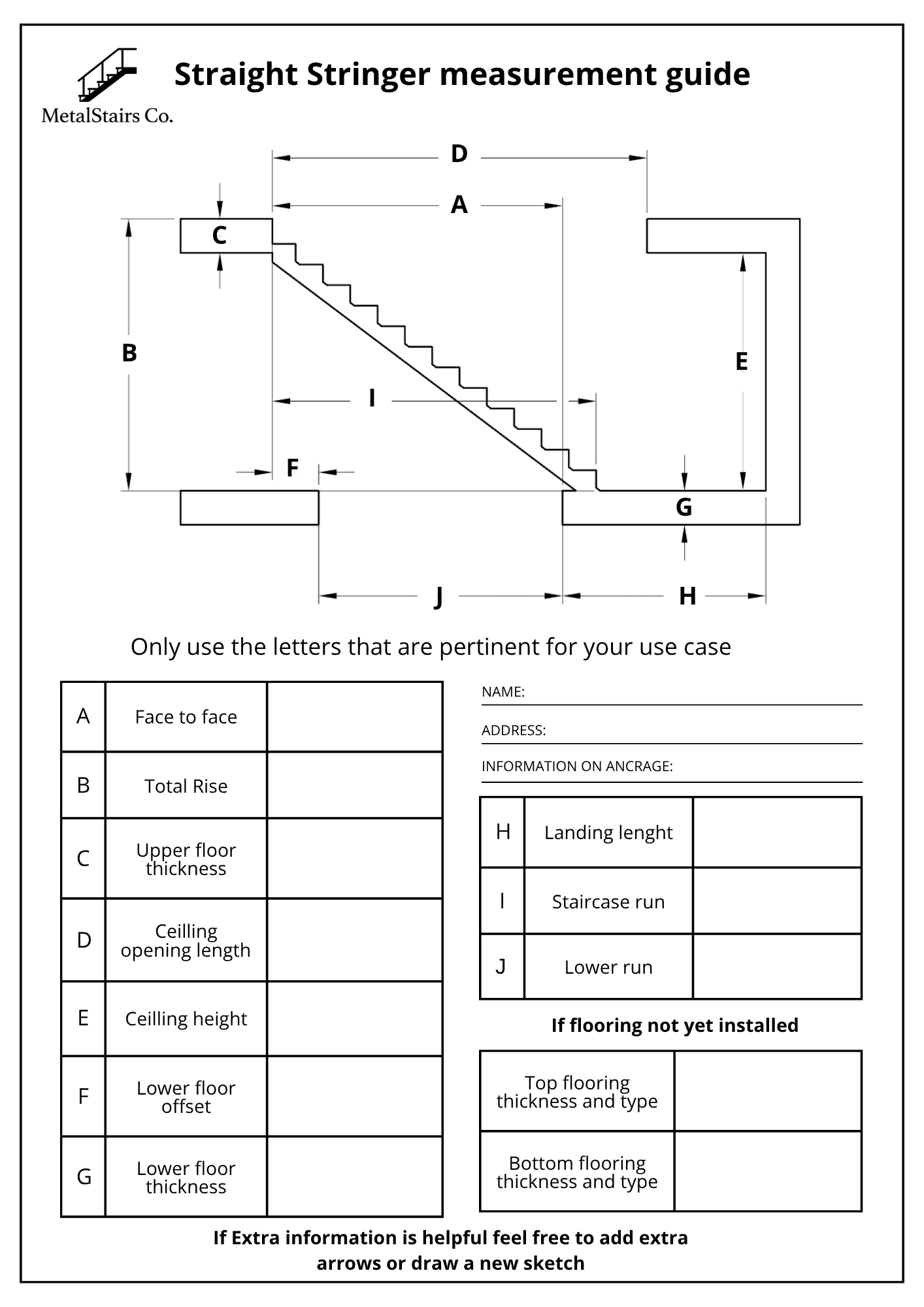
  • A: Face to face: horizontal distance between the drywall of the upper floor and the drywall of the landing

  • B: Total Rise: what we build everything around. Don't measure directly under the opening. Measure at the spot where the stringer foot will actually land using a laser level. Nearly every floor has a tilt

  • C: Upper floor thickness: height where the anchorage plate will sit. If your finished flooring is not yet installed at the top level, do not include it in this measurement

  • D: Ceiling opening length: to determine the headroom

  • E: Ceiling height: bottom floor to ceiling directly above the stair path, to determine the headroom

  • F: Lower floor offset: horizontal offset from both floors measured with laser level

  • G: Lower floor thickness: floor assembly at the bottom level if pertinent

  • H: Landing length: to help see if there is enough space

  • I: Staircase run: full horizontal distance of the staircase if there is a constraint

  • J: Lower run: length of the hole

What we need to know

  • Is the finished flooring already down at the top level? At the bottom?

  • If not: what type and how thick? (ex. 3/4" hardwood, 12mm tile, etc.)

  • Is the drywall installed?

  • What material are you anchoring into at the top and at the bottom? (wood joist, LVL, concrete, steel beam)

    Send all your photos and videos by text to 506 300-2002 or upload them to Google Drive, Dropbox, or any sharing platform and send the link to avery@metalstairsco.ca.

The more photos and videos you send, the faster we can quote and the less back and forth before fabrication.

  • A: Face to face: horizontal distance between the drywall of the upper floor and the drywall of the landing

  • B: Total Rise: what we build everything around. Don't measure directly under the opening. Measure at the spot where the stringer foot will actually land using a laser level. Nearly every floor has a tilt

  • C: Upper floor thickness: height where the anchorage plate will sit. If your finished flooring is not yet installed at the top level, do not include it in this measurement

  • D: Ceiling opening length: to determine the headroom

  • E: Ceiling height: bottom floor to ceiling directly above the stair path, to determine the headroom

  • F: Lower floor offset: horizontal offset from both floors measured with laser level

  • G: Lower floor thickness: floor assembly at the bottom level if pertinent

  • H: Landing length: to help see if there is enough space

  • I: Staircase run: full horizontal distance of the staircase if there is a constraint

  • J: Lower run: length of the hole

What we need to know

  • Is the finished flooring already down at the top level? At the bottom?

  • If not: what type and how thick? (ex. 3/4" hardwood, 12mm tile, etc.)

  • Is the drywall installed?

  • What material are you anchoring into at the top and at the bottom? (wood joist, LVL, concrete, steel beam)

    Send all your photos and videos by text to 506 300-2002 or upload them to Google Drive, Dropbox, or any sharing platform and send the link to avery@metalstairsco.ca.

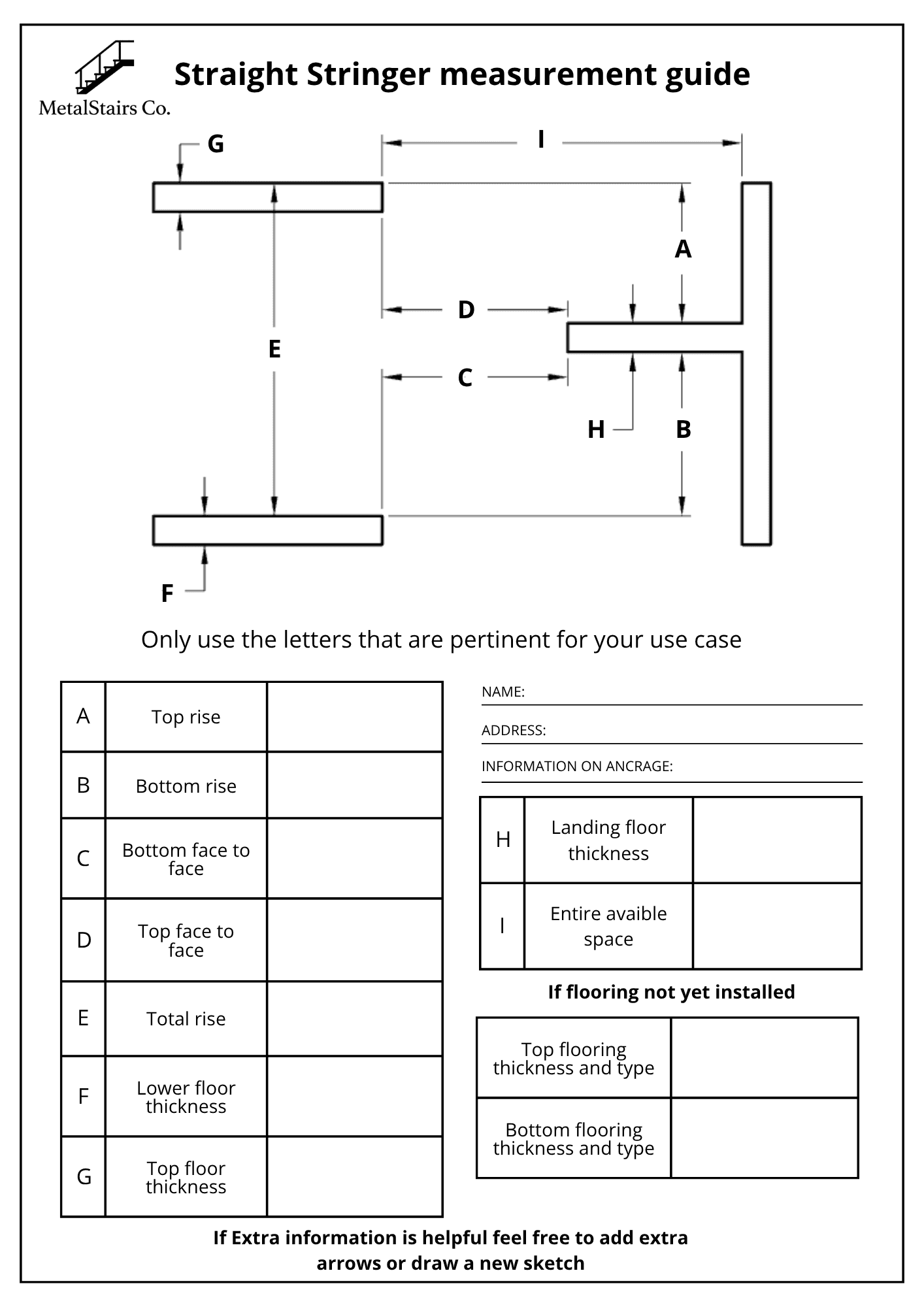
2 Straight stringers separated by an existing landing
The more photos and videos you send, the faster we can quote and the less back and forth before fabrication.

  • A: Top rise: vertical height of the upper flight, from the landing to the top floor

  • B: Bottom rise: vertical height of the lower flight, from the bottom floor to the landing

  • C: Bottom face to face: horizontal distance between the landing structure and the bottom floor wall

  • D: Top face to face: horizontal distance between the top floor structure and the landing structure

  • E: Total rise: full vertical height from bottom floor to top floor

  • F: Lower floor thickness: vertical thickness of the floor assembly at the bottom level

  • G: Top floor thickness: height where the top anchorage plate will sit. If your finished flooring is not yet installed, do not include it in this measurement

  • H: Landing floor thickness: vertical thickness of the landing structure where the middle anchorage plate will sit

  • I: Entire available space: full horizontal span from the top floor structure to the far wall, to determine if both flights fit

What we need to know

  • Is the finished flooring already down at the top level? At the bottom?

  • If not: what type and how thick? (ex. 3/4" hardwood, 12mm tile, etc.)

  • Is the drywall installed?

  • What material are you anchoring into at the top and at the bottom? (wood joist, LVL, concrete, steel beam)

    Send all your photos and videos by text to 506 300-2002 or upload them to Google Drive, Dropbox, or any sharing platform and send the link to avery@metalstairsco.ca.

The more photos and videos you send, the faster we can quote and the less back and forth before fabrication.

  • A: Top rise: vertical height of the upper flight, from the landing to the top floor

  • B: Bottom rise: vertical height of the lower flight, from the bottom floor to the landing

  • C: Bottom face to face: horizontal distance between the landing structure and the bottom floor wall

  • D: Top face to face: horizontal distance between the top floor structure and the landing structure

  • E: Total rise: full vertical height from bottom floor to top floor

  • F: Lower floor thickness: vertical thickness of the floor assembly at the bottom level

  • G: Top floor thickness: height where the top anchorage plate will sit. If your finished flooring is not yet installed, do not include it in this measurement

  • H: Landing floor thickness: vertical thickness of the landing structure where the middle anchorage plate will sit

  • I: Entire available space: full horizontal span from the top floor structure to the far wall, to determine if both flights fit

What we need to know

  • Is the finished flooring already down at the top level? At the bottom?

  • If not: what type and how thick? (ex. 3/4" hardwood, 12mm tile, etc.)

  • Is the drywall installed?

  • What material are you anchoring into at the top and at the bottom? (wood joist, LVL, concrete, steel beam)

    Send all your photos and videos by text to 506 300-2002 or upload them to Google Drive, Dropbox, or any sharing platform and send the link to avery@metalstairsco.ca.

General stair guidelines

Whatever the project, our team will provide recommendations based on the National Building Code of Canada. That said, it is the client's responsibility to verify requirements with their municipality and/or insurer to confirm what applies to their specific situation.


Stair dimensions

  • Rise: min 5" (125mm), max 7 7/8" (200mm), measured tread surface to tread surface

  • Run: min 10" (255mm), max 14" (355mm), measured nosing to nosing

  • Max nosing projection: 1" (25mm), rounded or beveled edge

  • Open risers (no kick plate) are legal as long as a 4" (100mm) sphere cannot pass through the opening

  • Headroom clearance: min 6'5" (1950mm) measured vertically from the nosing line


Guardrails

  • Required when the floor drop exceeds 24" (600mm)

  • Interior residential height: min 36" (900mm) measured from tread nosing

  • Baluster spacing: max 4" (100mm), no sphere larger than 4" can pass through

  • Guardrail must be structurally supported at a minimum of 3 points: top, bottom, and at least one mid-point


Handrails

  • Required on at least one side for any stair with 3 or more risers

  • Required on both sides when the stair width exceeds 42" (1067mm)

  • Height: min 34" (865mm), max 42" (1070mm) measured from nosing

  • Must be continuously graspable throughout the full length of the stair
FAQs

How long does it take to build my stairs?

Do you deliver and install across New Brunswick?

Do you handle installation?

Who takes the measurements?

FAQs

How long does it take to build my stairs?

Do you deliver and install across New Brunswick?

Do you handle installation?

Who takes the measurements?

FAQs

How long does it take to build my stairs?

Do you deliver and install across New Brunswick?

Do you handle installation?

Who takes the measurements?